What to Ask Before Hiring a Chartered Building Surveyor

A chartered building surveyor is a property professional who has passed the Assessment of Professional Competence and is a qualified member of the Royal Institution of Chartered Surveyors (RICS). That membership means they've demonstrated technical competence across construction, defect diagnosis, valuation and contract law, and that they operate under RICS's professional and ethical standards, including mandatory professional indemnity insurance and a formal complaints procedure.
This distinction matters more than it might seem. In the UK, the term "surveyor" isn't legally protected, so anyone can call themselves one regardless of training. "Chartered" status, however, is protected and independently verifiable. It's why organisations like ours hold both RICS membership and accreditation with The Academy of Experts, giving clients a second layer of assurance when it comes to technical assessments and construction expert witness work.
In short: chartered status is a regulated, verifiable qualification, whereas "surveyor" on its own guarantees nothing.
What Questions Should You Ask Before Hiring a Chartered Building Surveyor?
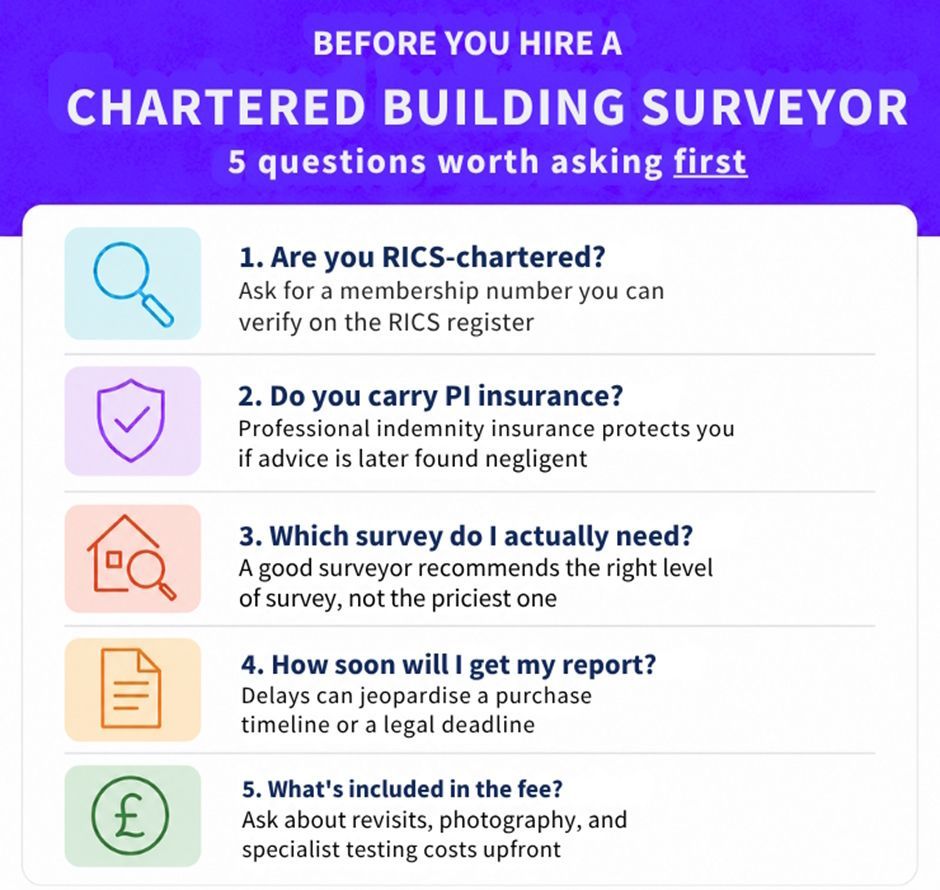
Once you've shortlisted a few firms, a short conversation before you commit can save considerable time, money and stress later. Consider asking:
● Are you a chartered member of RICS, and can I see your membership number? Anyone can check this on the RICS Find a Surveyor tool, so a confident, verifiable answer is a good early sign.
● Do you carry professional indemnity insurance? This protects you if advice later turns out to be negligent.
● What type of survey or service do I actually need? A full building and structural survey suits older or unusual properties, while a straightforward valuation might suit a newer build. A good surveyor will steer you towards the right option rather than the most expensive one.
● How quickly will I receive a written report? Delays can jeopardise a purchase timeline or a legal deadline, particularly with dilapidations claims or lease-end disputes.
● What's included in the fee, and are there additional costs? Ask specifically about site revisits, photography, or specialist input such as damp or timber decay testing.
● Have you worked on similar properties or disputes before? Experience with, say, Victorian terraces, ecclesiastical buildings, or a specific type of party wall matter can make a real difference to the quality of advice.
In short: the right questions reveal whether a surveyor is qualified, insured, experienced and genuinely suited to your specific property or dispute.
How Can You Compare Different Surveying Firms?
With several RICS-chartered firms often available in the same area, the decision usually comes down to depth of experience, communication and value for money rather than qualification alone. It helps to compare firms side by side against the same criteria:
| What to check | Chartered building surveyor | Non-chartered "surveyor" |
|---|---|---|
| RICS membership | Verifiable via RICS Find a Surveyor | Not applicable |
| Professional indemnity insurance | Mandatory under RICS rules | Not guaranteed |
| Formal complaints route | RICS-regulated redress scheme | Limited or informal |
| Ongoing training | Mandatory CPD required by RICS | Not required |
| Expert witness / court credibility | Recognised standard for legal proceedings | Rarely accepted as expert evidence |
| Local market knowledge | Varies by firm — worth asking directly | Varies |
Beyond this baseline, look at how a firm communicates during the enquiry stage. Do they ask sensible questions about your property before quoting? Do they explain technical terms clearly? A firm that offers project management and contract administration alongside surveying, rather than a one-off report, can also be useful if you're likely to need ongoing support through a build or dispute.
In short: compare firms on qualifications, insurance, communication and breadth of service, not just on price.
Why Does Local Experience in Borehamwood, Watford and Greater London Matter?
Building surveying is rarely a purely technical exercise; it's shaped by local construction methods, planning authorities and property types. A surveyor who regularly works across Borehamwood, Watford, Barnet and the wider Greater London and Home Counties area will already be familiar with:
● Common defects in the area's Victorian, Edwardian and interwar housing stock
● Local planning department expectations, which is invaluable for planning application advice
● Typical party wall issues that arise from the tightly packed terraces and semis common across North London and Hertfordshire
● Reliable local contractors and specialists who can be brought in for further investigation where needed
A firm without this local grounding may still produce a technically competent report, but they're less likely to flag the subtler, area-specific risks that experience teaches you to look for.
In short: local knowledge helps a surveyor spot the defects and risks that are specific to your area, not just the generic ones.
Why Choose Us for Your Chartered Surveying Needs?
We've been providing chartered building surveying services from Borehamwood for over 30 years, working across residential, commercial, educational, institutional and ecclesiastical properties throughout Greater London and the South East. Every principal at our firm is a qualified member of the RICS and The Academy of Experts, which means every survey, valuation, or piece of expert witness advice we provide meets a consistent, independently regulated standard.
What sets us apart isn't just the accreditation, though. It's the breadth of service under one roof: full building surveys, party wall agreements, construction dispute consultancy, dilapidations and project management, delivered by a team who genuinely know this part of London and Hertfordshire. You can read more about our team's background and the full range of our professional services elsewhere on this site.
In short: three decades of local, RICS-regulated experience across multiple property types means one firm can usually cover everything you need, from first survey to final dispute resolution.
Frequently Asked Questions
Do I need a chartered surveyor if I'm buying a new-build home? Yes, it's still worth it. Even recently constructed properties can have hidden snagging issues, poor workmanship, or defects that only a trained eye will catch before your warranty period narrows.
How much does a chartered building survey typically cost? Costs vary depending on property size, age and the type of survey required. We're happy to provide a tailored quote once we understand your property and requirements; get in touch via our contact page.
Can a chartered building surveyor act as an expert witness in a dispute? Yes. RICS-chartered status is widely recognised by courts and tribunals as a mark of credible, independent expertise, which is why chartered surveyors are frequently instructed for expert witness work in property and construction disputes.
What's the difference between a homebuyer's report and a full building survey? A homebuyer's report is a lighter-touch assessment suited to conventional properties in reasonable condition, while a full building survey offers a much more detailed, room-by-room structural assessment, better suited to older, unusual or altered properties.
How long does a typical building survey take? The site visit itself usually takes a few hours depending on the size and complexity of the property, with the written report typically following within a few working days.
Ready to Speak to a Chartered Building Surveyor?
Whether you're weighing up an offer on a property, dealing with a party wall notice, or need expert witness support for a construction dispute, we're happy to talk through your situation. Contact our Borehamwood team today on 020 8207 6100 or email info@simonlevy.net to discuss how we can help.
Sources and Further Reading
● RICS – Find a Surveyor – verify a surveyor's chartered status and RICS membership
● GOV.UK – The Party Wall etc. Act 1996 – official guidance on party wall procedures
● RICS Consumer Guides – Home Surveys – independent guidance on choosing the right type of survey